
· by Michael Blair, Nashville's Pool & Spa
Pool interior finishes wear out, and some of the signs can be felt underfoot or seen in the test results before the surface looks bad from the deck. This is what we check when someone asks whether their pool is due, why the water decides so much of how long a finish lasts, and what a resurface involves on our renovation and resurfacing jobs.
How long does a pool finish last?
We do not put a single number of years on plaster, quartz or pebble, because nobody can promise one honestly: the water a finish sits in does a large share of the deciding. Pebble Technology International, the maker of PebbleTec, says in its pool care instructions that maintaining proper water chemistry is essential to reaching the expected longevity of a pool surface.
The numbers in writing are warranties, and a warranty is a floor rather than a forecast. PebbleTec’s warranty page covers its materials for a minimum of five years from installation, and the authorized installer covers workmanship for at least five years; its PebbleQuartz line starts at one year and moves to five years on materials and two on workmanship if the owner registers the finish within 30 days. The same page asks for the water chemistry records with any material claim. Plain white plaster carries whatever its applicator puts in writing, so ask to see it before the job starts.
What are the signs a pool needs resurfacing?
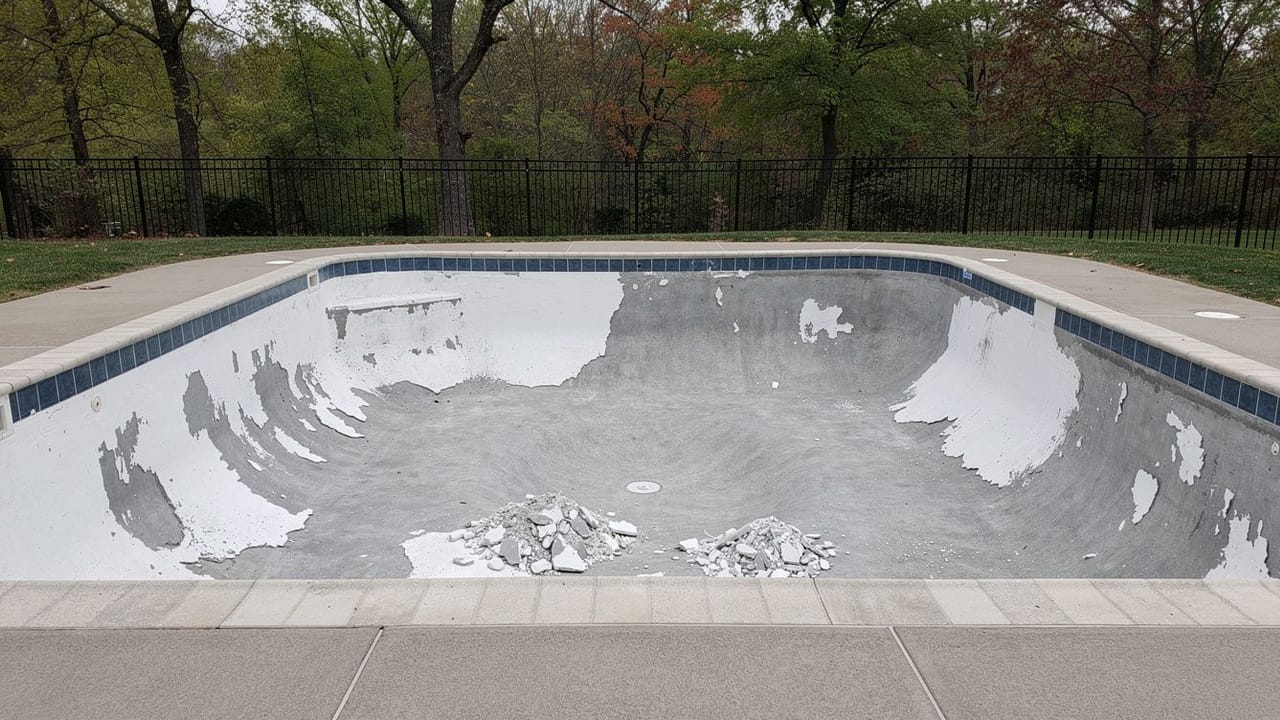
Roughness underfoot, where the surface has worn and feels like fine sandpaper on bare feet. Staining that will not brush out. Visible spidering or cracking. Exposed aggregate or bare patches where the finish has gone thin.
Then the indirect one: chemical use creeping up and water that will not hold its balance from one week to the next. Test results on their own do not prove the finish is at fault, so they send us to look hard at the surface before anyone decides. A pool that keeps losing water is a separate question, and our leak detection service is where we would start on that one.
- Roughness underfoot
- Staining that will not brush out
- Cracking, spidering or bare patches
- Rising chemical use and balance that drifts
- Persistent water loss, which may be more than surface wear
Chemistry shortens or extends it
Water out of balance works on a finish from one of two sides. Water on the acidic side, low in calcium or alkalinity, can dissolve calcium-based material; water carrying more calcium than it can hold leaves it behind as scale. The USGS page on hardness of water shows both halves in household terms: hard water that is heated deposits calcium carbonate scale, and an acid such as vinegar helps dissolve mineral deposits. PebbleTec describes all of its aggregate finishes as pebbles and cement, and its care instructions warn that high chlorine concentrations can make minerals precipitate as cloudy water, scale or stain.
Nashville’s tap water is not soft to begin with. Metro Water Services’ 2025 water quality report lists average total hardness of 100.5 mg/L and calcium hardness of 79.5 mg/L, puts it down mostly to dissolved calcium from the limestone of Tennessee and eastern Kentucky, and notes that treatment does not remove it.
That number is only where a fill starts. Top-ups, a softener on the hose bib and the chemicals added each week all move the numbers, so we test calcium hardness and alkalinity alongside pH instead of assuming them, and on our weekly pool service the readings are written down. PebbleTec recommends testing at least once a week and keeping the printed reports in case a warranty request needs them.
What does resurfacing a pool involve?
On our resurfacing jobs the pool is drained, the old surface is chipped out down to a sound base and the new finish is applied. Then comes the start-up, when a new finish gets the closest attention it will ever get. PebbleTec’s instructions give a sense of how close: no filling with softened water before the finish has cured, brushing three times a day for the first three days and twice a day for the next ten, at least 14 days before the heater goes on, at least 28 days before salt goes in on a salt system, and about 28 days before judging the final color of the water and finish.
With the pool empty, it is also a sensible time to deal with loose coping, cracked waterline tile or a structural repair, so we look at all three before the new finish goes on. A resurface can be a sizable contract, and in Tennessee the Board for Licensing Contractors requires a license before a contractor bids on, or negotiates the price of, a project of $25,000 or more. Our post on hiring a licensed pool contractor shows how to check one. When you want us to look at your finish, ask for a free estimate.
Sources
- Pebble Technology International, Pool Care Instructions — Water chemistry essential to a finish’s expected longevity; test at least weekly and keep reports; aggregate finishes are pebbles and cement; high chlorine can precipitate minerals as scale or stain; start-up: no soft water fill, brushing schedule, 14 days before heating, 28 days before salt, about 28 days before judging color.
- Pebble Technology International, Warranties — Materials covered a minimum of 5 years; installer workmanship at least 5 years; PebbleQuartz 1 year, or 5 years materials and 2 years workmanship if registered within 30 days; water chemistry records with claims; warranty applies only with an authorized installer.
- U.S. Geological Survey, Hardness of Water — Heated hard water deposits calcium carbonate scale; acidity helps dissolve mineral deposits.
- Metro Water Services, 2025 Consumer Confidence Report — Average total hardness 100.5 mg/L and calcium hardness 79.5 mg/L; hardness mostly dissolved calcium from limestone; treatment does not remove it.
- Tennessee Board for Licensing Contractors, Contractor License — License required before bidding or negotiating a price on projects of $25,000 or more.
FAQ
When a Pool Needs Resurfacing, and the Signs — questions
How long does pool plaster last?
There is no single honest number, because the water does a large share of the deciding. Water kept in balance and tested every week gives a finish its best chance, while aggressive or scaling water works against it. The figures in writing are warranties, which are a floor: PebbleTec, for example, covers its materials for at least five years. For plain plaster, ask the applicator what they warrant.
What is the first sign a pool needs resurfacing?
It can be something you feel before you see it: roughness underfoot where the surface has worn. Stains that will not brush out, cracking and bare patches are the visible ones. Water that keeps drifting out of balance, or needs more chemicals than it used to, is a reason to have the surface looked at, though it can have other causes.
Can I resurface a pool myself?
We would not advise it. Chipping out the old surface is heavy work, applying a new finish is skilled trowel work, and the start-up afterward needs close attention to the water and daily brushing for weeks. PebbleTec, for one, warrants its finish only when one of its authorized installers puts it on.
How long does pool resurfacing take?
The start-up runs longer than the work. After the pool is drained, chipped out and refinished, PebbleTec’s instructions call for brushing three times a day for three days and twice a day for ten more, at least 14 days before heating, 28 before adding salt, and about 28 before judging the final color.