
· by Michael Blair, Nashville's Pool & Spa
A dropping water level in July does not mean a leak on its own. The National Weather Service’s Nashville climate page puts the city’s normal July mean temperature at 80.7°F, an uncovered pool gives water up to the air every day in that kind of heat, and splash-out from people actually swimming adds to it. Before anyone starts cutting into a deck, it is worth establishing whether the loss is more than the weather accounts for.
How do you do a pool bucket test?
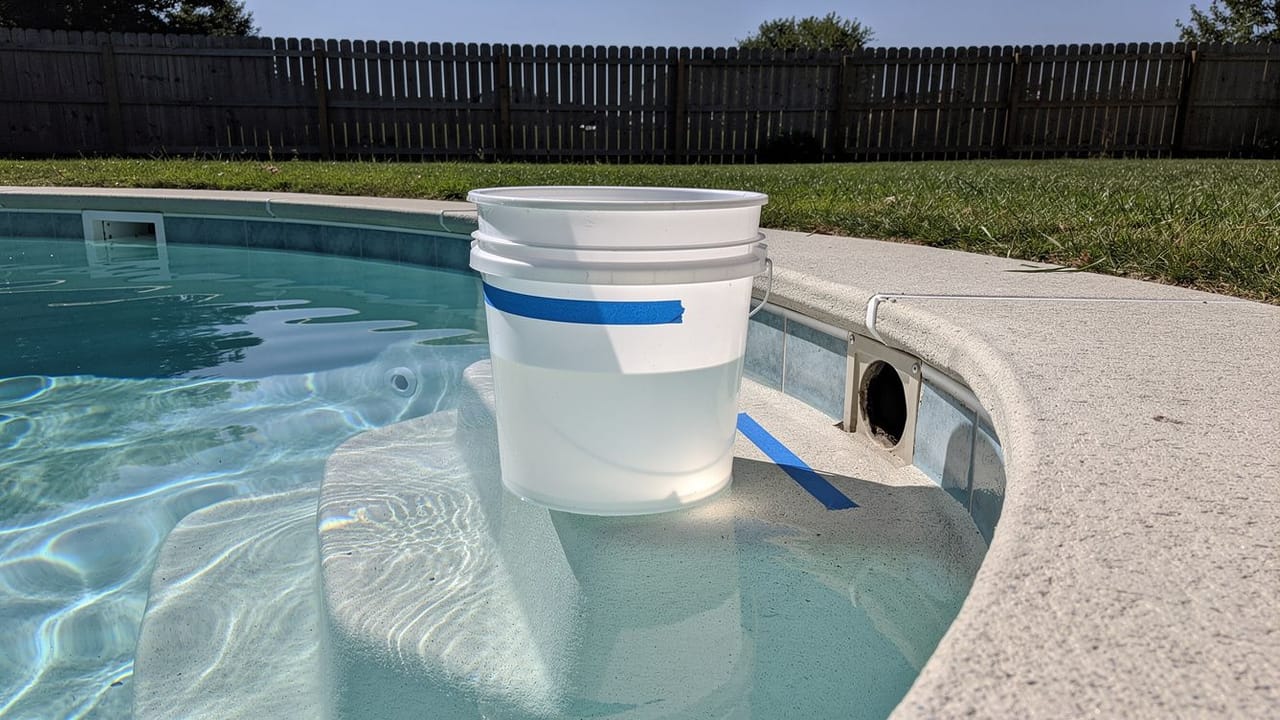
Fill a bucket with pool water and set it on a step so the water inside sits at the same level as the pool outside. Mark both levels. Leave the pump running on its normal schedule for a day, then compare. It’s the first thing we do on a pool leak detection visit, and you can run it yourself for nothing.
The bucket sits in the same sun and wind as the pool, so if the loss is evaporation the two should drop by about the same amount. If the pool has dropped noticeably further than the bucket, the difference points to a leak. Keep everyone out of the water on test day, because splash-out will throw the comparison off.
How do you narrow down where a pool is leaking?
Repeat the test with the pump off for a day. The return plumbing is only under pressure while the pump runs, so we read a pool that loses much more with the pump on as a pressure-side problem. A pool that loses more with the pump off points us at the suction side or the structure.
Then we check the obvious places: wet ground or one unusually green patch of grass near the pool, an equipment pad that stays damp, air bubbles coming out of the returns, or a pump that keeps losing prime. That last one also gets looked at as the pump itself, through our pool equipment repair work, before we blame the pipes. The skimmer throat, where the plastic meets the concrete, is a common leak point and one of the first places we put dye.
- Bucket test first, always, before anything else
- Compare loss with the pump running and with it off
- Check the skimmer throat and the light niche
- Look for damp ground or bright green grass near the pool
- Air in the pump basket sends us to the suction side
What usually leaks in a Middle Tennessee pool?
Freeze damage is where we start in this part of the state. The weather service’s Nashville records average 67 days a year with a low at or below 32°F, with the mean first one on November 11 and the mean last on March 31. NOAA’s 1991–2020 normals for the Nashville airport count close to 19 of those nights in an average January, and about 14 a year that reach 20°F or colder.
Water left in plumbing or equipment through a hard freeze can crack a fitting, and the crack may not show until the system is filled and running again in spring. So when a pool that was fine in October is losing water in April, we look first at whatever held water over the winter. Our post on opening and closing a pool in Middle Tennessee covers draining the lines so it doesn’t happen.
The other pattern we look for is movement. The USDA’s official description of the Mimosa soil series, which it calls extensive in Tennessee’s Central Basin, has silty clay and clay from about six inches down to limestone bedrock. Not every yard around Nashville sits on ground like that, but where a deck and a shell move relative to each other the joints between them open, and cracks in the tile line, a failed expansion joint between the deck and the coping, and a skimmer pulling away from the shell are what we find. Those are pool renovation and tile repairs as much as leak repairs.
When to stop testing and call
Once you have established a real loss and narrowed it to the pressure side, the suction side or the structure, tell us what you found when you book a leak detection visit, since it shortens the search. On site we pressure test individual lines and put dye at fittings, lights and skimmers, and you see what we found before any repair is quoted.
Do not let a genuine leak run through a season. Every top-up is fresh water that has to be balanced again, and the water leaving the pool is going into the ground somewhere, sometimes right under the deck. We would rather repair a pipe than rebuild a deck base that has spent a summer wet.
Sources
- National Weather Service Nashville, Nashville Climate Records — July normal mean temperature 80.7°F; 67 days a year with a minimum at or below 32°F; mean first freeze November 11, mean last March 31
- NOAA NCEI, 1991–2020 monthly climate normals, Nashville International Airport (USW00013897) — Average days with a low at or below 32°F by month (18.8 in January); monthly days at or below 20°F, which sum to about 14 a year
- USDA NRCS, Official Series Description: Mimosa series — Clayey residuum over phosphatic limestone; silty clay and clay subsoil; extensive in the Central Basin of Tennessee
FAQ
Why a Pool Loses Water and How to Find It — questions
How much water loss is normal for a pool?
Some loss is normal in a Middle Tennessee summer, and how much depends on temperature, humidity, wind and whether the pool is covered. We do not quote a single figure for it. The bucket test measures your pool in your weather over the same day, which tells you more than an average would.
Can a pool leak be repaired without draining?
Sometimes. Leaks at a skimmer, a light niche or the tile line can be candidates for a repair with the water in, and plumbing leaks are reached at the pipe rather than through the shell. Do not drain a pool yourself to go looking. Ask the builder or the contractor doing the repair first, because an in-ground shell is built to sit full and emptying it carries risks of its own, particularly when the ground around it is wet.
Does a pool cover reduce water loss?
A cover on the water cuts how much it gives up to evaporation while it is on, which is the part of the loss the weather causes. It does nothing for a leak, so a pool that keeps dropping with the cover on still needs testing. Take the cover off for the day you run the bucket test, so the pool and the bucket sit in the same sun and wind.
Where do pools most commonly leak?
The skimmer throat, where the plastic meets the concrete, is one of the most common, along with the light niche, the tile line and fittings cracked by water left in them through a freeze. Where the deck and shell move on clay, the expansion joint at the coping can fail and the skimmer can pull away from the shell.