
· by Michael Blair, Nashville's Pool & Spa
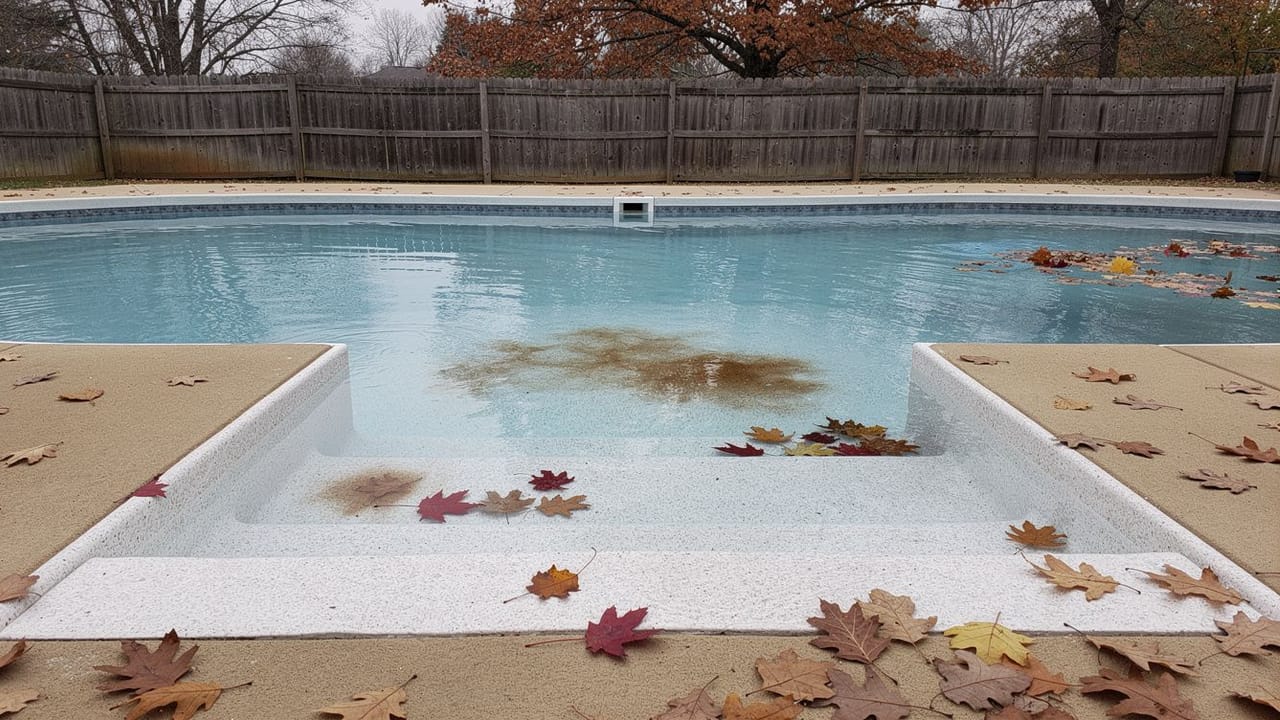
Leaves come down all over Middle Tennessee every fall, and a pool under oaks, maples and sweetgums catches a good share of them. Leaves that sink and sit on the floor give off tannins, which the U.S. Geological Survey’s page on water color traces to organic matter from leaves, roots and plant remains, comparing the result to a cup of tea. On plaster or a light finish, that color can stay behind as a brown mark in the shape of the leaf. Leaves also add an organic load that pulls the chlorine down, and they pack into skimmer and pump baskets. None of it is hard to manage, but it asks for more attention than the pool needed in August.
What do fallen leaves do to pool water?
A leaf is organic material, and the World Health Organization’s guidelines for swimming pools describe organic load in pool water as something that reduces the residual disinfectant level. That’s why a chlorine reading that held steady all summer can start slipping once leaves pile in. The same guidelines say algae can grow only where phosphate, nitrogen and potassium are present in the water, which is the other reason we lift leaves out instead of leaving them to break down on the floor.
Test more often during the drop, not less. Leaves netted off the surface before they sink cost almost nothing to deal with; leaves left lying on the floor cost chlorine, time and sometimes a stain. When the whole pool takes on a faint yellow or tea tint, rather than a few spots, the tannins are dissolved through the water, and our order is the same each time: leaves out first, then a shock, with the filter running. Water that looks milky instead of tinted is a different problem, and our post on cloudy pool water covers what to test for it.
How do you tell a leaf stain from a metal stain?
A leaf stain is brown or tea-colored, often keeps the outline of the leaf, and turns up where leaves sat: the deep end, the steps, corners the circulation doesn’t reach. Brown on its own doesn’t prove the stain is organic, though. Too much iron can give water a brown hue as well, the same USGS page notes, and a stain from metal in the water is treated differently, so we test before we treat.
Our test is to hold a chlorine tablet, or a little granular chlorine in a sock, against the stain for a few seconds on a pole. If the spot lightens, it’s organic. If it doesn’t, we try an ascorbic acid tablet held the same way, and a stain that answers to that and not to chlorine points toward metal. Organic stains get shock and brushing, and we give them several days. A metal stain also means tracking down where the metal is coming from, and a finish that won’t come clean after all of that is a question for our renovation and resurfacing work.
How do leaves affect the pool pump?
A skimmer basket full of wet leaves chokes off the water feeding the pump. When one of Hayward’s variable-speed pumps reports that it failed to prime, the steps in Hayward’s EcoStar troubleshooting guide run from air leaks on the suction side and the basket lid’s O-ring to the filter, skimmer and pump baskets, which it says to inspect for obstructions or debris. We would rather switch a pump off than leave it running short of water, so at the peak of the drop we empty skimmer baskets daily and look in the pump strainer basket just as often. A pump that has already run starved is a job for our equipment repair team.
A leaf canister is an inline trap on the vacuum hose, and with one in place the leaves vacuumed off the floor stop there instead of reaching the pump. Cutting back limbs that hang straight over the water lightens the load in every fall that follows.
- Skim the surface before leaves sink
- Empty skimmer baskets daily during the drop
- Check the pump basket and listen for the pump pulling air
- Use a leaf canister on the vacuum line
- Test chlorine more often, and shock after heavy days
Close early, or keep it running
Some owners close before the leaves fall so the cover takes the whole drop. On a mesh safety cover we rake or blow the leaves off the top. On a solid cover, rainwater and leaves collect together in a sagging layer, so we keep a cover pump on it. A leaf net stretched over either one turns the clean-up into lifting the net and carrying it off.
Closing early means closing water that is still warm, so we set the closing chemistry with that in mind. Keeping the pool open through the drop and closing once the trees are bare is the other route, with more skimming along the way. Either way, we don’t put a cover over leaves lying on the floor, where they would sit in the water until spring. Our post on opening and closing a pool in Middle Tennessee walks through the rest of a closing, and if you would rather hand the fall off to our weekly pool service, ask us for a free estimate.
Sources
- U.S. Geological Survey, Water Science School: Water Color — Tannin comes from organic matter from leaves, roots and plant remains and colors water like tea; too much iron can give water a brown hue
- World Health Organization, Guidelines for Safe Recreational Water Environments, Volume 2: Swimming Pools and Similar Environments (2006) — Organic load reduces the residual disinfectant level; algal growth is possible only if phosphate, nitrogen and potassium are present in pool water
- Hayward, EcoStar and EcoStar SVRS Troubleshooting Guide — For a failed prime: check suction-side air leaks and the basket lid O-ring, then inspect the filter, skimmer and pump baskets for obstructions or debris
FAQ
Leaf Drop, Tannin Stains and the Fall Pool — questions
Will leaf stains come out of pool plaster?
Leaf stains are organic, and we treat them with a chlorine shock and brushing over several days. A stain that does not lighten with chlorine is more likely metal and needs a different treatment.
Should I close my pool before or after the leaves fall?
Either works if it is done carefully. Closing early puts the leaves on the cover, ideally with a leaf net over it, but the closing chemistry has to allow for warmer water. Closing late means more skimming, but the pool goes under the cover clean.
Is it bad to leave leaves in the pool under the winter cover?
We would not do it. Leaves on the floor sit in the water all winter, adding organic matter that draws down the chlorine left in the pool and giving the tannins months to mark the finish. Vacuum the floor and empty the baskets before the cover goes on.
How do you remove leaves from a pool cover?
With a mesh safety cover, the leaves get raked or blown off the top. On a solid cover, rainwater and leaves collect together in a sagging layer, so a cover pump stays on it. A leaf net stretched over either kind turns the clean-up into lifting the net off and carrying it away.