
· by Michael Blair, Nashville's Pool & Spa
A hot tub holds a few hundred gallons of water at body temperature, and every soak adds soap carried in on skin and swimsuits, along with body oils and lotion. Keeping that water clear is a matter of routine. Winter adds a second job, keeping the plumbing from freezing in a Middle Tennessee cold snap, and that mostly comes down to knowing what the tub does when the power goes off.
Why does hot tub water go bad faster than pool water?
A pool has tens of thousands of gallons and a hot tub has a few hundred, so each person in the water is a far larger share of the load. Hot Spring’s owner’s manual traces the soap to two places, the residue left on skin after a shower and the detergent left in swimsuits, and says the sanitizer a tub needs rises sharply once guests start using it. Heat works against you as well: the same manual notes that scale forms more readily at higher water temperatures.
That is why tub water is tested and dosed on a short cycle and replaced on a schedule rather than kept indefinitely. The manual is plain that soap is not oxidized by any chemical added to the spa, ozone being the one exception, so it builds up until the water foams and leaves an unclean feeling on the skin. At that point the remedy is a drain and refill.
The routine
Hot Spring tells owners to test the water weekly or before each time the spa is used, and the readings that matter are sanitizer, pH, total alkalinity and calcium hardness, with pH held between 7.2 and 7.8. Dose sanitizer to your system’s label, and add more after a long session, since the manual says an afternoon or evening of use calls for extra. Shock or super-chlorinate weekly or monthly, depending on the sanitizing program you run. For the filter, Hot Spring’s water care guide says to rinse it with a garden hose once a month and soak it in filter cleaner every time the tub is drained, and its maintenance page says to replace the cartridges every three years. On a tub used most evenings we rinse more often than that, because a filter matted with body oils is the first thing we look at when the water dulls.
The manual puts the water change at every three to four months, and up to twelve on a tub run with Hot Spring’s salt system and proper care; heavy use or foam that will not settle brings it forward. Before draining, see whether your manual calls for a jet or line flush, which on Hot Spring models is a job for the clean cycle. Refill water deserves a test of its own. Metro Water Services’ 2025 water quality report gives Nashville’s total hardness as 100.5 mg/L and calcium hardness as 79.5 mg/L, from 2023 data, which puts the city’s water right on the line its own table draws between medium hard and hard. That calcium figure sits inside the 75 to 150 ppm range Hot Spring suggests, but the manual warns that high calcium or a pH above 7.8 leaves scale on the shell and heater, so check both every time the tub is refilled.
- Test weekly, or before each soak
- Dose sanitizer to the label, more after a long session; shock weekly or monthly by system
- Rinse the filter monthly, soak it at every drain, replace it every three years
- Drain and refill every three to four months, and test hardness and pH on the refill
What makes hot tub water cloudy?
The troubleshooting guide in Hot Spring’s manual lists dirty filters first, then excess oils and organic matter, poor sanitizing, suspended particles, and water that is old or overused. Its glossary adds a pH above 7.8 and high calcium as causes of cloudiness. We work through it in that order, starting with the filter, because it is the cheapest thing to rule out. Foam on the surface is soap, and the manual says foam inhibitors can suppress it but cannot remove the soap, so a water change is the real fix. The same chemistry runs on a much bigger scale in a pool, which is covered in our post on why pool water goes cloudy.
Cloudiness that clears with a filter clean and a shock was most likely a filter or sanitizer problem. Cloudiness that comes straight back on water past the three-to-four-month mark has reached the last remedy on the manufacturer’s list, which is to drain and refill. We would rather drain at that point than keep adding clarifier to water that old.
Can a hot tub freeze during a Nashville winter?
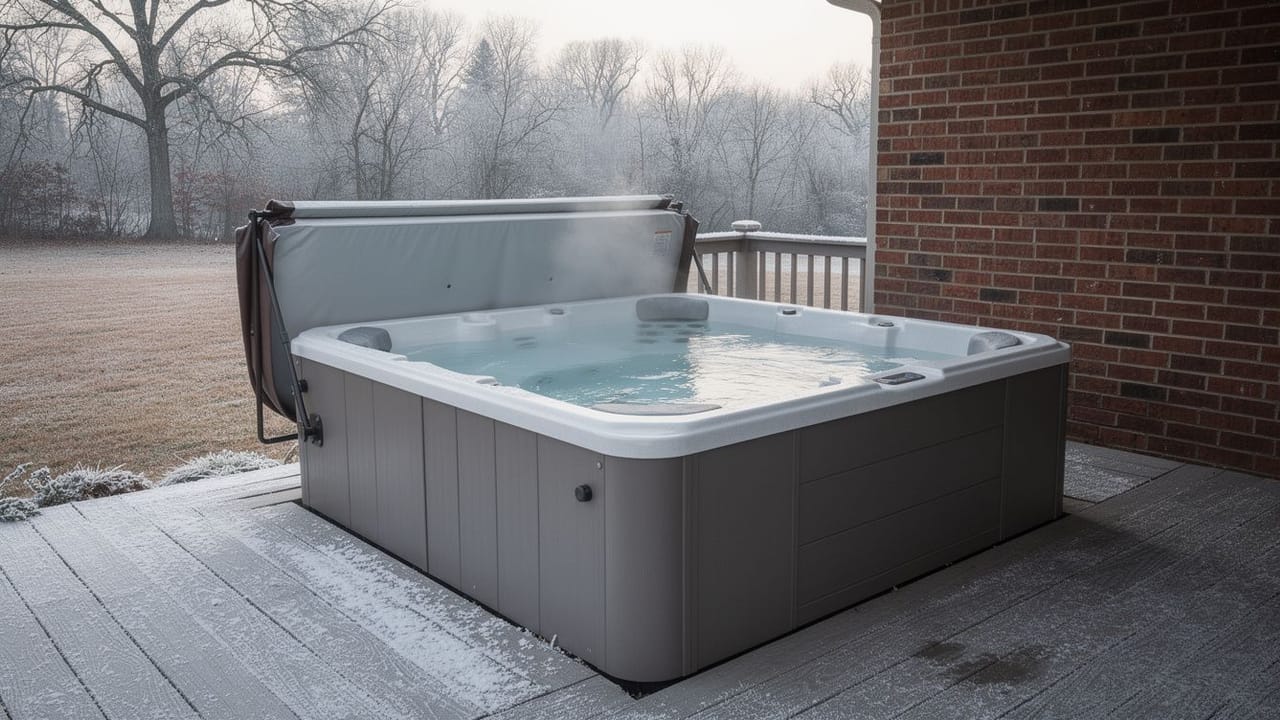
A tub that is running and heated rarely freezes, though Hot Spring’s manual warns that below 10°F with strong wind its jet pump can partially freeze even while the water stays at the set temperature. The bigger risk is a power cut or an equipment failure in a cold snap, and those are not rare here: NOAA’s 1991 to 2020 climate normals for Nashville’s airport average about 66 nights a year at 32°F or colder, and about 14 at 20°F or colder. The manual says the chance of water freezing inside the spa after an outage or malfunction rises as the set temperature is lowered, so winter is no time to turn the tub down to save a little power. Hot Spring’s maintenance page also recommends an insulated Winter Blanket inside the equipment compartment door as an extra guard against partial freezing.
If the power goes off in freezing weather, keep the cover on and locked, and if the outage looks like it will run long, call your dealer or ask us to come out before the lines have a chance to freeze. A tub that will sit unused through the winter should be drained and winterized, and draining alone is not enough here: the manual says that where temperatures fall below 32°F, a wet/dry shop vac must be used to clear the water trapped in the plumbing lines. The only antifreeze it allows is propylene glycol, sold at RV and marine supply stores, never automotive ethylene glycol, which is toxic. It also warns that freeze damage from a winterizing done wrong is not covered by warranty and strongly recommends having a dealer do it. A heater or pump that has already taken freeze damage needs diagnosing before the tub is refilled, which is part of our hot tub service, and closing a pool for the season is its own job, set out in our post on opening and closing a pool in Middle Tennessee.
Sources
- Hot Spring Spas (Watkins Wellness), Highlife Collection 2026 Owner’s Manual — Soap from skin and swimsuits; test weekly or before each use; pH 7.2 to 7.8; calcium 75 to 150 ppm; shock weekly or monthly; change water every three to four months (salt system up to twelve); foam inhibitors cannot remove soap; cloudy-water causes; scale; partial pump freezing below 10°F with wind; winterizing with a shop vac and propylene glycol
- Hot Spring, Hot Tub Water Care — Rinse filters with a garden hose once a month; soak in filter cleaner at every drain
- Hot Spring, Owners Maintenance and Tips — Replace filters every three years; Winter Blanket in the equipment compartment against partial freezing
- Metro Water Services, 2025 Consumer Confidence Report — Nashville total hardness 100.5 mg/L and calcium hardness 79.5 mg/L (2023 data); hardness scale
- NOAA NCEI, U.S. Climate Normals 1991-2020, Nashville International Airport — About 66.3 nights a year at or below 32°F and 13.7 at or below 20°F
FAQ
Keeping a Hot Tub Clear Through Winter — questions
How often should hot tub water be changed?
Hot Spring’s owner’s manual says every three to four months, and up to twelve months on its salt system with proper care. Heavy use shortens that. Soap from skin and swimsuits builds up and no spa chemical other than ozone breaks it down, so once the water foams or feels unclean it is time to drain, whatever the calendar says.
Why does my hot tub keep going cloudy?
Hot Spring’s troubleshooting guide lists dirty filters first, then oils and organic matter, poor sanitizing, suspended particles and old water, and a pH above 7.8 or high calcium can cloud it too. Clean the filter, shock, and bring pH and alkalinity back into range; if the cloudiness returns on water three or more months old, drain and refill.
Will my hot tub freeze in a Tennessee winter?
A running, heated tub rarely does, though Hot Spring warns its jet pump can partially freeze below 10°F in strong wind. The real danger is a power cut or a failed heater on one of the roughly 66 nights a year Nashville drops to 32°F or below. Keep the cover locked on and the set temperature up, and if the tub will sit unused, have it drained, blown out with a shop vac and winterized with propylene glycol.
How often should you clean a hot tub filter?
Hot Spring says to rinse it with a garden hose once a month, soak it in filter cleaner every time the tub is drained, and replace the cartridges every three years. On a tub used most evenings we rinse more often, because a filter matted with body oils is the first suspect when the water dulls.